
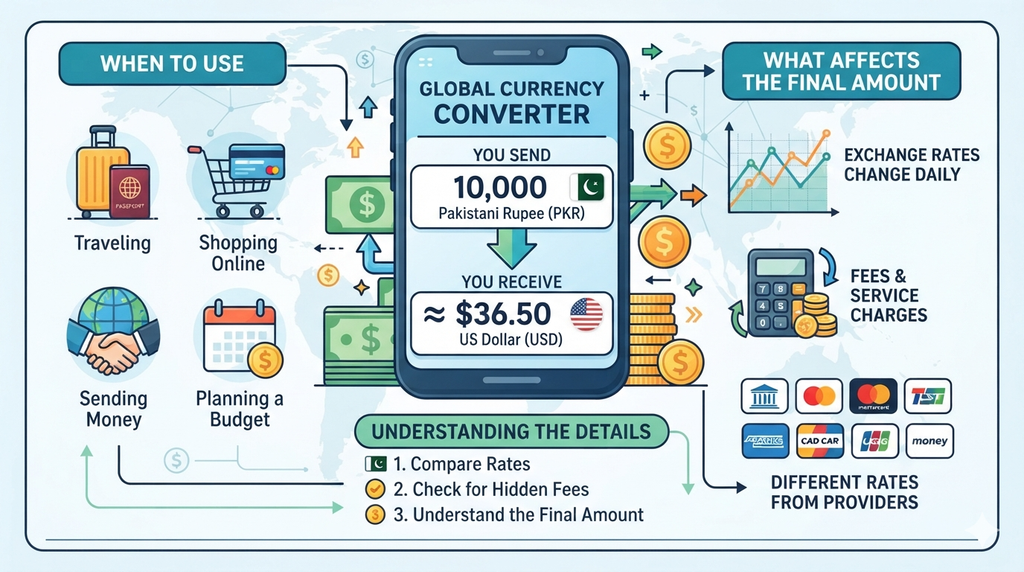

When you need to change one currency into another, a currency converter makes the process simple. You can quickly see how much your money is worth in another currency. This is useful when traveling, shopping online, sending money abroad, or planning an international budget. Exchange rates can change throughout the day, so the value you see today may differ tomorrow. A good converter helps you understand these changes before making a decision. For example, you may want to convert Pakistani rupees into US dollars before an online purchase. You might also compare euros, pounds, Canadian dollars, or Australian dollars. The basic process is easy, but the final amount can include fees. Banks, card providers, and money transfer services may use different rates. Understanding these details helps you avoid surprises. This guide explains currency conversion in simple terms. It also covers exchange rates, fees, common mistakes, and practical examples.
What Is a Currency Converter?
A currency converter is a tool that changes an amount from one currency into another. It uses an exchange rate to calculate the converted value. For example, you can enter an amount in Pakistani rupees and select US dollars. The tool then shows the estimated dollar value based on the selected rate. This can save time because you do not need to perform the calculation yourself. Many online tools update their rates regularly. However, the displayed rate may not match the amount you receive from your bank. Financial providers can add fees or use their own exchange margins. A converter is therefore best used as a planning tool. It gives you a useful estimate before you complete a transaction. You should always check the final rate with your bank or payment provider. This is especially important for large international transfers. Small rate differences can become significant when the transaction amount is high.
How Does Currency Conversion Work?
Currency conversion works by using an exchange rate between two currencies. The rate tells you how much one currency is worth compared with another. Suppose one US dollar equals a certain number of Pakistani rupees. You can multiply your dollar amount by that rate to estimate the rupee value. The reverse calculation requires division by the same rate. Exchange rates are influenced by many economic factors. These include inflation, interest rates, trade, economic growth, and market demand. Political events can also affect currency values. Because these factors change, exchange rates can move frequently. A currency converter uses a selected rate to perform the calculation quickly. Some tools use market rates, while financial providers may use customer rates. The difference between these rates matters when you exchange real money. Always check whether the displayed rate includes fees. A rate without fees may look better than the actual rate you receive.
Why Do Exchange Rates Change?
Exchange rates change because currencies are traded in global financial markets. Supply and demand play a major role in this movement. When demand for a currency rises, its value can increase against another currency. Economic news can also affect market expectations. For example, changes in interest rates may influence investors and currency demand. Inflation is another important factor. Countries with different inflation levels can experience changes in relative currency values. Government decisions, elections, trade policies, and global events may also create market movement. These changes explain why the result from a currency converter can differ from one day to another. Even short periods can produce noticeable differences for major transactions. This does not mean every currency moves dramatically each day. Some currencies may remain fairly stable for certain periods. Others can experience larger swings. Checking the current exchange rate before an international payment can therefore be useful.
Currency Converter Example
Imagine you want to convert 50,000 Pakistani rupees into US dollars. The first step is selecting PKR as the original currency. Next, select USD as the target currency. The converter then applies the current exchange rate. Suppose the rate shown is 280 PKR for one USD. The calculation would be 50,000 divided by 280. This gives an estimated value of about 178.57 USD. Your actual payment could be different because the provider may add a fee. The provider could also use an exchange rate with a small markup. This example shows why a currency converter is useful for estimates. It lets you understand the approximate value before spending or transferring money. The same method works with euros, pounds, Canadian dollars, Australian dollars, and many other currencies. Always confirm the final rate before completing an important transaction. This simple habit can help you make better financial decisions.
How to Convert Currency Manually
You can convert currencies manually when you know the current exchange rate. The basic formula is straightforward. To convert the base currency into the target currency, multiply or divide according to the quoted rate. For example, assume one euro equals 300 Pakistani rupees. To convert 15,000 PKR into euros, divide 15,000 by 300. The result is 50 euros. To convert 50 euros into Pakistani rupees, multiply 50 by 300. The result is 15,000 PKR. A currency converter performs these calculations automatically. This reduces the chance of making a simple mathematical mistake. However, manual calculations still help you understand the result. They can also help when you are traveling without reliable internet access. Remember that real-world rates may include transaction charges. Therefore, a manual calculation usually represents an estimate. For large amounts, compare the provider’s final quote before sending or exchanging money.
Currency Conversion for Travelers
Travelers often need to compare prices in their home currency. A currency converter can make this much easier. Imagine you are visiting another country and see a hotel priced at 100 euros. You may want to know its approximate cost in Pakistani rupees. Converting the price helps you decide whether the hotel fits your budget. The same approach works for restaurants, transport, attractions, and shopping. It is useful to check rates before your trip. You can then create a realistic daily spending plan. Travelers should also consider card fees and ATM charges. Your bank may apply a foreign transaction fee when you pay abroad. Some ATMs may also charge their own service fee. The exchange rate used by your card network can differ from a public market rate. A converter gives you a helpful benchmark. It should not be treated as a guarantee of the final amount.
Using a Currency Converter for Online Shopping
International shopping has become common, but prices can be confusing. An online store may display prices in dollars, euros, pounds, or another currency. Converting the price lets you compare it with local alternatives. For example, you may find a product listed for 75 USD. You can convert that amount into your local currency before deciding to buy. Remember that the final cost may include shipping, taxes, customs duties, and payment fees. These extra charges can make a large difference. A currency converter only handles the currency portion of the calculation. It does not automatically include every shopping cost. Your bank may also use a different exchange rate. Therefore, check the checkout amount before confirming your purchase. Currency conversion is especially useful for expensive electronics, subscriptions, clothing, and digital services. Comparing the total cost helps you make a smarter purchase decision. It also prevents unexpected charges on your card statement.
Currency Conversion for International Money Transfers
People send money internationally for many reasons. They may support family members, pay overseas suppliers, or cover education expenses. In these cases, exchange rates can have a meaningful impact. A small difference in the rate may change the amount received. A currency converter helps you estimate the value before sending money. However, you should compare the complete transfer cost. A provider may advertise a competitive exchange rate but charge a transfer fee. Another provider may offer a lower fee but a less favorable exchange rate. The most useful comparison is the final amount received. Always check the recipient’s expected amount before confirming a transfer. Also consider transfer speed and payment method. Some services provide faster delivery at a higher cost. Others may take longer but offer better pricing. Reading the full transaction details can help you choose the most suitable option.
Mid-Market Rates vs Provider Rates
The mid-market exchange rate is often used as a useful reference point. It represents the midpoint between buying and selling rates in the broader market. Many public currency tools show a rate close to this figure. However, consumers may not receive that exact rate. Banks and money transfer providers can add a margin. This difference is sometimes called an exchange-rate markup or spread. For example, a public converter may show one rate while your card statement shows another. This does not necessarily mean the conversion was incorrect. It may reflect the provider’s pricing model. Understanding this difference makes currency comparisons easier. When comparing services, look at the actual amount you will receive. Do not focus only on the advertised exchange rate. Also check transaction fees and other charges. A slightly different rate may still produce a better overall deal when fees are lower.
Popular Currency Pairs to Convert
Some currency pairs are used more often than others. USD and EUR are among the most widely traded currencies. GBP, JPY, CAD, AUD, CHF, and other major currencies are also commonly converted. People in Pakistan often need to compare PKR with currencies such as USD, GBP, EUR, AED, and SAR. The right currency pair depends on your needs. A student may convert PKR into GBP for education expenses. A traveler may compare PKR with AED before visiting the United Arab Emirates. An online shopper may need USD or EUR conversion. Businesses may monitor several currencies when dealing with overseas customers. A currency converter makes these comparisons quick. You can usually select both currencies from a list. Some tools also allow you to save common currency pairs. This is helpful when you repeatedly check the same currencies. Always confirm that you selected the correct currency code before calculating.
Currency Codes You Should Know
Currency codes make international money conversion easier. They usually contain three letters and follow international standards. For example, USD represents the United States dollar. EUR represents the euro, while GBP represents the British pound. PKR represents the Pakistani rupee. CAD is the Canadian dollar, and AUD represents the Australian dollar. JPY represents the Japanese yen. AED represents the United Arab Emirates dirham. SAR represents the Saudi riyal. Knowing these codes helps prevent confusion between currencies with similar names. It is especially useful when using financial websites or international payment platforms. A currency converter usually displays both the currency name and its code. Always check both before entering an amount. This simple step can prevent an incorrect conversion. Currency codes are also useful when reading invoices, bank statements, travel prices, and international contracts.
How to Choose a Reliable Currency Converter
Not every conversion tool provides the same information. A reliable currency converter should clearly identify its exchange-rate source. It should also explain how frequently rates are updated. A clean interface makes it easier to enter amounts and select currencies. You should avoid tools that provide unclear pricing information. For real transactions, check the rate directly with your bank or payment service. A public conversion tool is useful for comparison, but it may not show your final customer rate. It is also helpful to check whether the tool supports the currencies you need. Some services provide historical rates and charts. These features can help you understand recent market movement. However, past performance does not guarantee future exchange rates. For important transactions, use information from trusted financial providers. Compare the complete cost instead of focusing on one number. This approach gives you a more realistic view of your transaction.
Common Currency Conversion Mistakes
One common mistake is assuming the public exchange rate is the final rate. Banks and payment providers may add margins or fees. Another mistake is converting the wrong currency pair. Similar currency names can create confusion. People also sometimes forget about taxes, shipping costs, or international transaction fees. These charges can make the final amount higher. Another issue is relying on an old exchange rate. Currency values can change after you check them. If you are planning a large transaction, refresh the rate before making a payment. It is also important to check the direction of conversion. Converting USD to PKR is different from converting PKR to USD. A simple calculation error can produce a misleading result. Finally, avoid comparing providers using exchange rates alone. Check the total amount paid and received. This gives you a much clearer picture of the actual cost.
Currency Converter for Business and Budget Planning
Businesses often deal with customers, suppliers, or employees in different countries. Currency conversion can therefore become part of everyday financial planning. A company may need to estimate revenue in its local currency. It may also calculate the cost of imported products. Exchange-rate changes can affect profit margins and budgets. A currency converter provides quick estimates during planning. For example, a business can convert a foreign supplier’s quote into its home currency. It can then compare that cost with local suppliers. Businesses should use official financial records for final accounting. Public conversion tools are better suited for estimates and planning. Companies may also track exchange rates over time. This helps them understand how currency movement affects their operations. Larger organizations may use specialized financial systems for more detailed calculations. Regardless of business size, clear currency information supports better decisions.
Why Currency Conversion Matters in Daily Life
Currency conversion is no longer limited to banks and travelers. Many people interact with foreign currencies every week. Streaming services, software subscriptions, online stores, and digital platforms may charge customers internationally. Freelancers can also receive payments from clients in different countries. Students may pay international tuition or application fees. Families may receive money from relatives living overseas. Each situation can involve an exchange rate. Understanding currency values helps people estimate their real costs. It also makes international prices easier to compare. A currency converter provides a quick starting point for these decisions. You can use it before purchasing a service or sending money. However, always check the final transaction amount. Your payment provider may apply a different rate. Knowing this difference can help you plan your budget more accurately.
Tips for Getting Better Currency Conversion Results
Start by checking the rate shortly before your transaction. This is especially important for larger payments. Next, compare at least two providers when the amount is significant. Look at the final amount rather than the advertised rate alone. Check transfer fees, card charges, and other service costs. If you are traveling, consider how you will pay for everyday expenses. Carrying a small amount of local cash may be useful. Cards can provide convenience, but foreign transaction fees may apply. When shopping online, check the currency used at checkout. Do not assume that the store’s displayed price includes every cost. For budgeting, leave some room for exchange-rate changes. This is helpful when planning trips or long-term expenses. Finally, use trusted financial sources for important decisions. These simple habits can make currency conversion easier and more predictable.
Frequently Asked Questions About Currency Conversion
1. What is the easiest way to convert currencies?
The easiest method is to use an online currency converter. Enter the amount and select both currencies. The tool calculates the estimated value using its current exchange rate. For important transactions, compare this result with your bank’s quoted rate.
2. Are currency converter rates always accurate?
Currency tools can provide useful and current estimates. However, they may not show the exact customer rate from your bank. Financial providers can add margins, fees, or other charges. Always check the final rate before completing a transaction.
3. Why is my bank’s exchange rate different?
Banks and payment providers may use their own customer exchange rates. They can include an exchange-rate margin or transaction fee. This means the final amount may differ from a public market rate. Comparing the total cost is more useful than comparing rates alone.
4. Can I use a currency converter while traveling?
Yes. Travelers can use conversion tools to compare hotel prices, food costs, transport, and shopping expenses. Checking rates before a trip can also help create a better budget. Remember that card and ATM fees may affect the final cost.
5. Does currency conversion include transaction fees?
Usually, a basic converter only calculates the exchange value. It does not automatically include bank charges, transfer fees, taxes, or card fees. You should add these costs separately when estimating the final payment.
6. Which currencies can I convert?
The available currencies depend on the tool. Most major converters support popular currencies such as USD, EUR, GBP, JPY, CAD, AUD, and PKR. Some tools also support many smaller or less frequently traded currencies.
Conclusion: Make Smarter Decisions With Currency Conversion
Understanding currency values can make international spending much easier. A currency converter gives you a quick way to estimate prices across different currencies. It can help with travel, online shopping, international transfers, business planning, and everyday budgeting. However, the displayed rate should usually be treated as an estimate. Your bank or payment provider may apply another rate. Fees and exchange-rate margins can also affect the final amount. For this reason, always compare the complete transaction cost. Check the currency pair, update the rate, and review the final payment details. These simple steps can prevent costly surprises. Whether you are converting PKR to USD or comparing euros and pounds, basic knowledge goes a long way. Use conversion tools as a planning aid, then confirm important transactions with your financial provider. With the right information, you can approach international money decisions with greater confidence.